

This little tip has stood me well in finding “missing” male head-of-household ancestors in the 1850-1880 US census, and might help you, too! (Note that I’ll be saying “him” a lot in this post because in this case we’re usually seeking a fellow.)
(Its better than shouting “Show yourself!” at your computer screen when your ancestors insist on hiding.)
In a nutshell: Make use of the agricultural schedule.
What is the Agricultural Schedule?
Before we dive in, let me clarify: The agricultural schedule was a special census that recorded information about farms and farmers in the United States. Unlike the regular population schedule we typically think about when we think “census,” this schedule focused specifically on documenting farm ownership and production. It’s available for the years 1850-1880 and can be found on major genealogy websites like Ancestry and FamilySearch.
Here’s how:
Step 1: Create Your Search Hypothesis
Before doing anything else:
- Identify where you think your ancestor lived during the target year
- Calculate their approximate age at the time
- List who should have been in their household
This preparation is crucial because the results might be a little… wild.
Step 2: Search the agricultural schedule
For me, the whole purpose of this tip is to avoid having to read an entire county (or at least district) census. So here’s how to make this as quick and painless as possible:
- Start with a database search at the major genealogy databases:
- Important: Don’t rely solely on database searches! These records can be challenging to read and are often poorly indexed. A manual review is often necessary.
Research Tip: The agricultural schedules weren’t preserved by the National Archives and many have suffered damage over time.1 You’ll often encounter blurry, stained, or torn pages that automated searches might miss.
When you find your ancestor (or if you don’t), document:
- The militia district or locality
- Names of farmers listed before and after your ancestor
- Pay special attention to unusual surnames – they’ll help you in step 3
- Note everything in your research log, even negative results
Agricultural Schedule Example
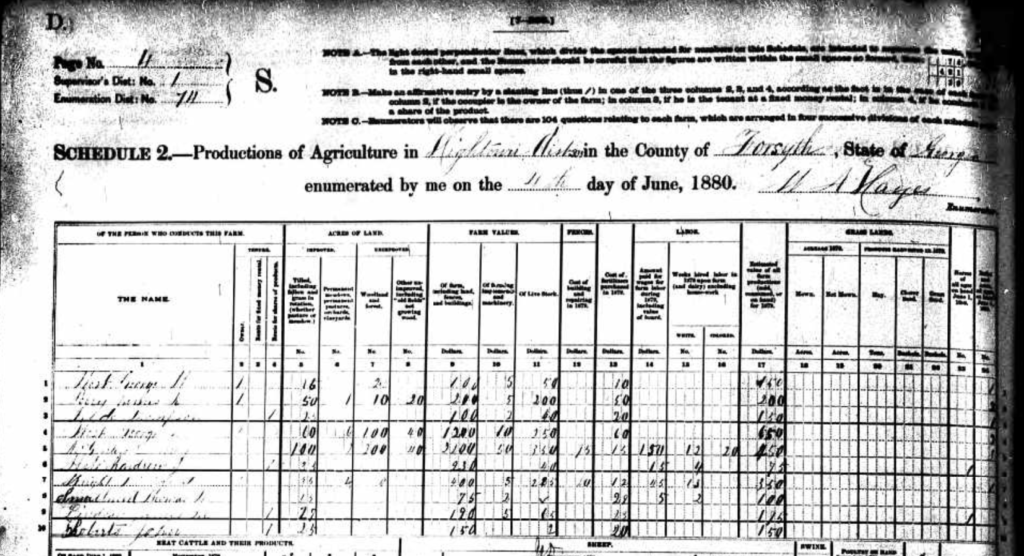
1880 U.S. Census, Forsyth County, Georgia, agricultural schedule, Hightown [sic], enumeration district (ED) 74, sheet D (stamped), p. 4 (penned); database with images, “U.S., Selected Federal Census Non-Population Schedules, 1850-1880,” Ancestry (https://www.ancestry.com/search/collections/1276/records/5403613 : accessed 15 Jan 2024), image 1 of 1; NARA microfilm publication T1137, roll 13, Records of the Bureau of the Census, Record Group 29, National Archives, Washington, D.C.
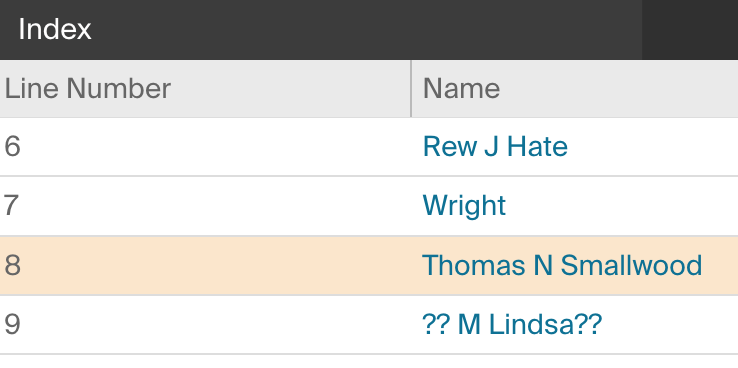
And here’s how Ancestry indexed those names in that ag schedule:
Step 3: Use Agricultural Schedule Neighbors to Find Population Records
And now for the moment of truth! Use those agricultural schedule neighbors to locate your ancestor in the main census:
- Search the population schedule for those same neighbors with unusual names
- Once you find a neighbor, verify you’re in the right area by checking if other agricultural schedule neighbors appear nearby
- Carefully examine entries around these confirmed neighbors
- Look beyond just names – check ages, household composition, and other details that match your hypothesis
Sometimes your ancestor is right there, hidden by creative spelling, fading, an ink blot, or poor handwriting that prevented them from appearing in database searches. Hooray!
How the Agricultural Schedule Revealed a “Missing” Ancestor
(Note: Client example used with permission.)
The Missing Census Entry
John PA Wall appeared in every census I expected to find him in – except 1850. Based on other records, I developed this search hypothesis:
- Age: Approximately 45 years old
- Location: Carroll County, Georgia
- Household: Living with wife Nancy and three daughters
- Time period: 1850
The Agricultural Schedule Search
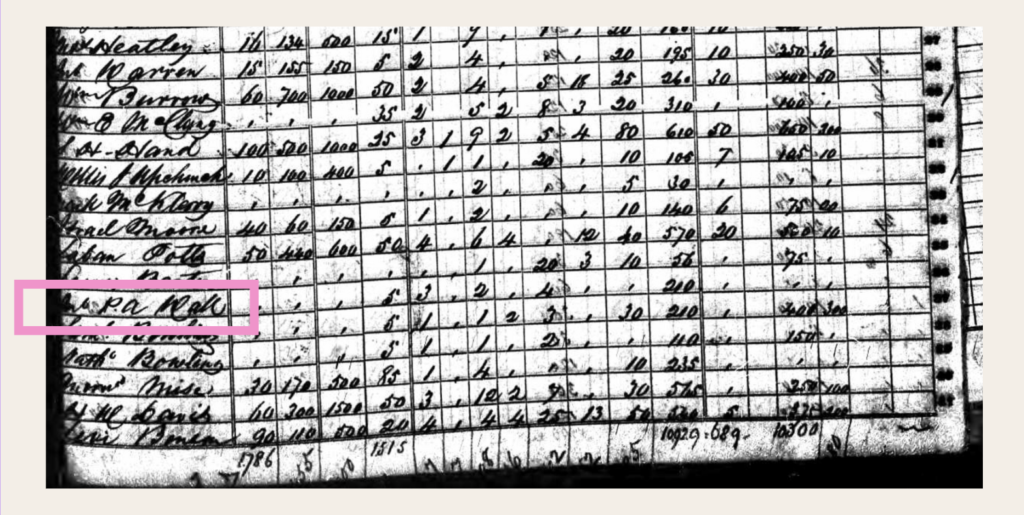
A database search revealed “Jno PA Wall” in the 1850 Carroll County agricultural schedule:
Following the Neighbors
The agricultural schedule showed Wall surrounded by his neighbors, some with more distinctive surnames than others:
- Upchurch
- Bowling
- Mise
- Potts
- McKlary
Using these neighbor names as guides, I searched the population schedule for the uncommon name “Upchurch.” This led me to discover our missing ancestor John PA Wall – listed as “Jno PA Ward“!

Confirming the Find
Several factors confirmed this was our John PA Wall:
- Correct age
- Wife Nancy present
- All three daughters present
- Location matched the hypothesis
- Neighbors matched the agricultural schedule
Research Lessons
- The distinctive “PA” initials proved crucial. Our research subject consistently used both initials in records, showing the importance of tracking name patterns.
- This case taught me to search for “John PA” when surname searches fail.
- The Wall surname often gets misread as similar names like Hall or, in this case, Ward.
Research Tip: When searching for ancestors with commonly misread surnames, try searching by their first name and any middle initials, especially if they used them consistently.
Why This Trusty Method Works
The agricultural schedule effectively gives you a second chance to find your ancestor. Since it was created independently of the population schedule but typically followed the same geographic path, it can help you overcome indexing errors or damage in the main census.
Remember: Not finding your ancestor in the agricultural schedule is also valuable information – it might indicate they weren’t a primary farmer or farm owner during that period.
Need Help?
Want to learn more about genealogy research techniques? Visit Copper Mine Genealogy for additional resources and professional assistance.
- Elizabeth Shown Mills, Evidence Explained: Citing History Sources from Artifacts to Cyberspace, 4th ed. (Baltimore: Genealogical Publishing Co., 2021), 255. [↩]
2 thoughts on “Missing from the Census? Try This Strategy”
I caught your great presentation today at the WABE Genealogy Workshop. I have a question on your blog topic of “missing head of household”.
I’m searching for a guy (James Sam Mewhinney) missing from the 1920 Census. In both the 1910 and 1930 Censuses, he is on the farm with his wife Stella and children (Buckholts, Milam County, Texas), but in the 1920 Census, his wife and child are living “in town” (Cameron, Texas), with his wife as head of household. James doesn’t seem to appear in the 1920 Census.
He was quite a prominent rancher throughout that time, holding a Vice President position in the Texas Stockman’s Association.
I have a theory of why the couple may have been separated at that time. I have DNA evidence indicating Stella’s child, James Sam Mewhinney Jr. (my biological grandfather) born 1913, was in fact James Senior’s brother’s child.
You mentioned in the workshop the Agricultural Schedules of the US Census. Is there a way to specifically query, or browse, that schedule for 1920 for Milam County Texas? I’m hoping to find some indicator of where James Same Mewhinney Sr. was residing in 1920.
Thanks for any suggestions.
Dave
Hi Dave,
I think your theory is sound and I really like your hypothesis! Unfortunately, the Census Agricultural schedules, while taken in 1920, have not been preserved. This is a big disappointment to us researchers since they held interesting information as the country transformed from mainly agrarian to more urban.
That said, tax records can be a good substitute here. Often tax records after 1900 are at the state archives and/or the county level. I’d contact the Texas State Library & Archives (here’s their tax roll page: https://www.tsl.texas.gov/arc/taxrolls.html ) to see if they have 1920 and the surrounding years. If he’s still in the area and under 60 years of age, he’ll likely be paying tax. I hope this helps!